Your Factory Is 110°F.
Here's the Fix.
Why smart manufacturers are ditching AC dreams and bringing the outside air in — on their terms.
If you run injection molding, rotational molding, blow molding, metal fabrication, or any process that generates serious heat, you already know the math: air conditioning a 67,000-square-foot facility isn't just expensive — it's practically impossible to justify. Yet every summer, your team sweats through shifts in conditions that hurt morale, safety, and productivity. There's a better path, and it doesn't require a chiller the size of a school bus.
The answer is controlled fresh-air ventilation — a push-pull system designed to flush out trapped heat and replace it with cooler outdoor air, delivered precisely where your people are working.
Why Passive Louvers & Exhaust Fans Fall Short
Many facilities try the obvious approach first: open up some wall louvers, flip on the rooftop exhaust fans, and hope nature does the rest. It rarely works well enough. The problem isn't the idea — it's the lack of control. Passive openings let air wander wherever it wants, which usually means it rises straight to the ceiling and exits without ever touching your workers at floor level.
- Air enters uncontrolled and rises
- Workers at floor level get little benefit
- Hot ceiling air recirculates downward
- No directional flow across the building
- Dependent on wind conditions outside
- Employees still feel stagnant, stale air
- Fans mounted 10–15 ft, aimed at floor level
- Fresh air delivered directly to workers
- Exhaust pulls heat away from production area
- Consistent airflow wall-to-wall across the building
- Operates independently of wind conditions
- Employees feel a constant fresh-air breeze
You're not just moving air — you're controlling where it goes, how fast it moves, and who benefits from it.
How the Push-Pull System Works
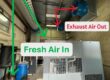
The design is elegantly straightforward: high-velocity supply fans bring outside air in through three sides of the building. That air is directed downward toward the floor — where employees are — creating an envelope of fresh, cooler air at ground level. Meanwhile, wall-mounted exhaust fans on the opposite side pull the hot, stale air up and out, creating a continuous cross-flow that sweeps heat out of the production zone.
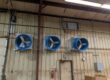
High-velocity fans installed at 10–15 feet pull outside air in and push it toward the floor, creating a low-level layer of cool, fresh air right where employees work.
The incoming air moves in a consistent direction across the full length of the building, sweeping heat ahead of it rather than letting it pool and stagnate.
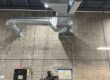
Wall-mounted exhaust fans draw hot air away from the production area and out of the building, completing the push-pull circuit.
Running the system overnight when outdoor temps drop lets the building mass absorb cooler air, giving your team a head start every morning before machines heat things back up.
The Science: Air Changes Per Hour
The effectiveness of any ventilation system comes down to one critical metric: how many times per hour the entire air volume in your facility is replaced. A building running at fewer than 4–5 air changes per hour (ACH) will struggle to overcome the heat load generated by manufacturing equipment. At 10 ACH — one complete air turnover every six minutes — you achieve a dramatic and sustained improvement in conditions.
To put it in concrete terms: a 1,323,000 cubic foot production floor running at 225,000 CFM of total supply air achieves approximately 10.1 ACH. On a 90°F day, even when interior temperatures have climbed to 110°F or more, a properly sized system can realistically bring that down to within 5°F of the outside temperature. That's the difference between dangerous and manageable.
Choose Your Level — Scale to Your Budget
One of the advantages of a fan-based ventilation system over traditional HVAC is that it scales. You don't have to commit to the maximum or nothing. Here's how different ACH targets translate to cost:
| ACH | Minutes / Air Turn | CFM | Investment |
|---|---|---|---|
| 8 | 7.5 min | 176,400 | $222,500 |
| 10 Recommended | 6 min | 225,000 | $280,000 |
| 12 | 5 min | 264,600 | $330,000 |
| 15 | 4 min | 330,750 | $417,000 |
The sweet spot for most manufacturing facilities is the 10 ACH solution. Beyond that point, diminishing returns set in — each additional degree of cooling requires disproportionately more equipment. A 6-minute air turnover delivers the conditions your employees need without over-engineering the system.
What Your Employees Actually Feel
The benefit that doesn't show up in the spec sheet is the one your employees will notice immediately: evaporative cooling. When a high-velocity stream of fresh outdoor air moves across the skin, it accelerates the body's natural cooling mechanism. Workers feel the difference within minutes of the system running — not just a marginal improvement, but the sensation of a real breeze in an environment that previously felt like a convection oven.
This matters beyond comfort. Heat stress is a genuine safety and productivity issue in manufacturing environments. Facilities that reduce ambient temperatures and increase air movement consistently report lower absenteeism, fewer heat-related incidents, and measurably higher output during summer months.
Ready to Breathe Easier?
From equipment procurement to full installation, a push-pull ventilation system can be operational in 6–8 weeks. Every installation is personally overseen by the owner, start to finish.
If your building is cooking your team and traditional cooling isn't in the budget, it's time to stop fighting the heat with inadequate tools. Bring the outside air in, push the heat out, and give your people the conditions they deserve to work in.
Get a Free Site Assessment
Every facility is different. Let's run the numbers for yours and find the right ACH solution for your budget.
Talk to an Expert Call us directly: 319-383-1072 · tanner@ventilationpros.com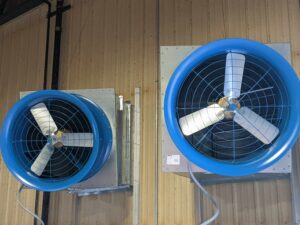
12,000 CFM High Velocity Fans
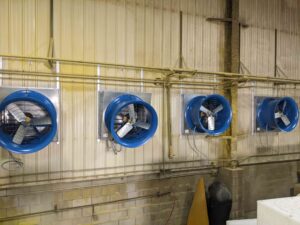
The quietest blade and maximum CFM