Summer is brutal in high-temperature manufacturing environments. Whether you’re running furnaces, kilns, ovens, heat-treat lines, foundries, or heavy machining operations, your facility is already generating extreme internal heat. When outside temperatures climb, the problem compounds — and productivity, safety, and equipment reliability all take a hit.
Most facilities already have one important piece of the puzzle in place: exhaust fans. The problem? Exhaust without adequate intake is like trying to breathe out without breathing in.
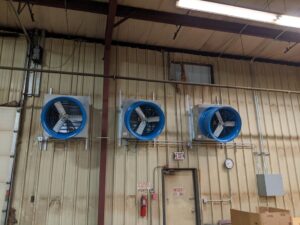
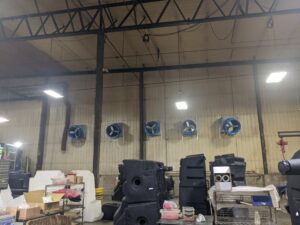
If you want real summer cooling performance, you must feed the exhaust — and that means installing and properly sizing high-velocity intake fans.
The Physics Is Simple: Air Has to Go Somewhere
Exhaust fans remove hot air from the building. But if there isn’t enough incoming air to replace it, several things happen:
- The building becomes negatively pressurized
- Air sneaks in through cracks, doors, and random openings
- Airflow becomes inconsistent and inefficient
- Exhaust fans underperform
- Hot air lingers longer than it should
You can’t pull air out of a sealed box. For exhaust to work efficiently, it needs a deliberate, controlled source of incoming air.
When It’s Cooler Outside Than Inside — Bring It In
This is the simplest cooling strategy available, and it’s often underutilized:
If outside air is cooler than inside air, bring the outside air inside.
In high-temp manufacturing, interior air can easily exceed outside ambient temperature — even in mid-summer. Furnaces and process heat don’t shut off just because it’s July.
Whenever outdoor air is even a few degrees cooler than indoor air, you have an opportunity to:
- Flush accumulated heat
- Reduce overall building temperature
- Improve worker comfort
- Lower equipment stress
- Reduce reliance on mechanical cooling systems
But passive openings or low-velocity make-up air units often aren’t enough. You need velocity and volume.
Why High-Velocity Intake Fans Matter
High-velocity intake fans create controlled, directional airflow. Instead of allowing air to lazily seep in, they:
- Push large volumes of cooler outside air deep into the facility
- Create intentional airflow paths toward exhaust locations
- Break up hot air stratification
- Improve air mixing
- Increase total air changes per hour
Think of it as creating a river of air that flows across the building — sweeping heat toward the exhaust fans.
Without velocity, incoming air stalls near the walls. With velocity, it travels.
Feeding the Exhaust: A Balanced System
Your exhaust fans already represent a capital investment. But they can only perform at their rated capacity if they are supplied with enough incoming air.
A properly designed summer ventilation strategy should:
- Match intake CFM to exhaust CFM
- Strategically place intake fans low and opposite major heat sources
- Use exhaust fans high in the building where hot air accumulates
- Create a consistent directional airflow path
When intake and exhaust are balanced:
- Negative pressure issues disappear
- Doors stop slamming or sticking
- Airflow becomes predictable
- Heat removal becomes efficient
This isn’t about adding more exhaust. It’s about enabling what you already have.
Stratification: The Hidden Enemy
Hot air rises. In manufacturing buildings with high ceilings, heat can accumulate 10–30 feet above the floor. Workers suffer at ground level while a massive reservoir of hot air sits overhead.
High-velocity intake air disrupts this layering effect by:
- Forcing circulation
- Reducing temperature gradients
- Helping exhaust fans remove accumulated heat more quickly
Without sufficient intake force, exhaust fans often pull from the easiest nearby air source — not the hottest air in the building.
Worker Comfort and Productivity
Heat stress is not just uncomfortable — it’s dangerous.
Improved airflow leads to:
- Lower perceived temperature
- Reduced fatigue
- Fewer heat-related incidents
- Better morale
- Higher output consistency
Even a 5–10°F reduction in indoor temperature can significantly impact safety and productivity.
Energy Efficiency Advantage
Mechanical cooling in high-temperature manufacturing is often impractical or cost-prohibitive. Moving air, however, is relatively inexpensive compared to refrigeration-based systems.
Using high-velocity intake fans to maximize natural temperature differentials:
- Reduces the load on HVAC systems
- Extends equipment life
- Minimizes emergency cooling costs
- Lowers overall energy spend
You’re leveraging physics instead of fighting it.
The Summer Strategy Checklist
If your facility runs hot in summer, ask:
- Are our exhaust fans operating at full rated performance?
- Do we have adequate intake CFM to match exhaust CFM?
- Is intake air entering with enough velocity to reach production areas?
- Are we intentionally directing airflow across heat-generating equipment?
- Are we capitalizing on cooler outside temperatures whenever possible?
If the answer to any of these is “no,” your exhaust system is likely underperforming.
Final Thought: Exhaust Alone Is Half a System
Many facilities focus on removing heat but forget the equally critical step of replacing air effectively.
Exhaust fans don’t solve overheating — balanced airflow systems do.
When outside air is cooler than inside air, the solution is straightforward:
Bring the outside, inside — with force, direction, and intention.
High-velocity intake fans aren’t an upgrade. In high-temperature manufacturing, they’re the missing half of the system.